Sealcoating and Asphalt Care in West St. Paul, MN
West St. Paul is older than its name suggests and smaller than its neighbor. Incorporated on February 23, 1889, it covers about 5 square miles of Dakota County on the west bank of the Mississippi. Its population went from 7,955 in 1950 to 13,101 in 1960 and 18,802 in 1970, then barely moved, reaching 20,615 in 2020. That shape points to a housing stock that grew fastest in the 1950s and 1960s, and to pavement that has had decades of Minnesota winters to crack, settle and collect patches.
The city's code carries an unusually broad rule. Section 150.008 says no person may lay, re-lay, repair or reconstruct any sidewalk, gutter, driveway or curb made of concrete or asphalt or other bituminous substance without a permit. Read literally, that covers repairing a driveway, not just building one, which reaches further than the rules in Saint Paul or Roseville. Whether a plain sealcoat counts is a question for the city, but patching, overlaying and replacing clearly do, so asphalt patching here starts at the permit counter.
free quotes, fast response, local pros.
Free quote
West St. Paul streets, alleys and snow emergencies
The city is responsible for 65 miles of streets and five miles of alleys, and it has been catching up on them. Voters approved a citywide sales tax in 2018, in effect since 2020 and earmarked for roads, and the city's pavement condition index reached 65 on a 100-point scale in 2021, in the fair range. Its menu of fixes is instructive: a full reconstruction lasts about 50 years, a mill and overlay 10 to 15, and a thinner in-house overlay 5 to 10. A driveway owner faces the same trade between rebuilding and resurfacing, on a smaller scale.
Snow emergencies are declared at 2.5 inches and last 72 hours. Enforcement starts at the following 2 a.m.: snow emergency routes are no-parking until fully plowed, and all other streets and alleys are no-parking from 8 a.m. until plowed or until 8 p.m., whichever comes first. Depositing snow from private property onto a public street is unlawful, and sidewalks must be cleared within 12 hours. With cars pulled onto driveways during those stretches and banks stacked along the edges, the corners of a drive stay wet well into the thaw.
See West St. Paul, MN on Google Maps — we cover the whole area from Saint Paul.
Asphalt Sealcoating Services Available in West St. Paul
Each service described on this site is also available in West St. Paul:
See the full pricing guide for typical ranges.
West St. Paul FAQs
Which West St. Paul driveway jobs fall under section 150.008?
The section names laying, re-laying, repairing and reconstructing driveways made of concrete, asphalt or other bituminous material. Patching a pothole, cutting out and replacing a failed section, overlaying the surface and full replacement all fit those words. Crack filling and sealcoating sit closer to routine maintenance, but the code does not define them, so the city's building office is the place to confirm before work begins, and asking first avoids a stop-work conversation halfway through a job.
Why do West St. Paul alley aprons break up?
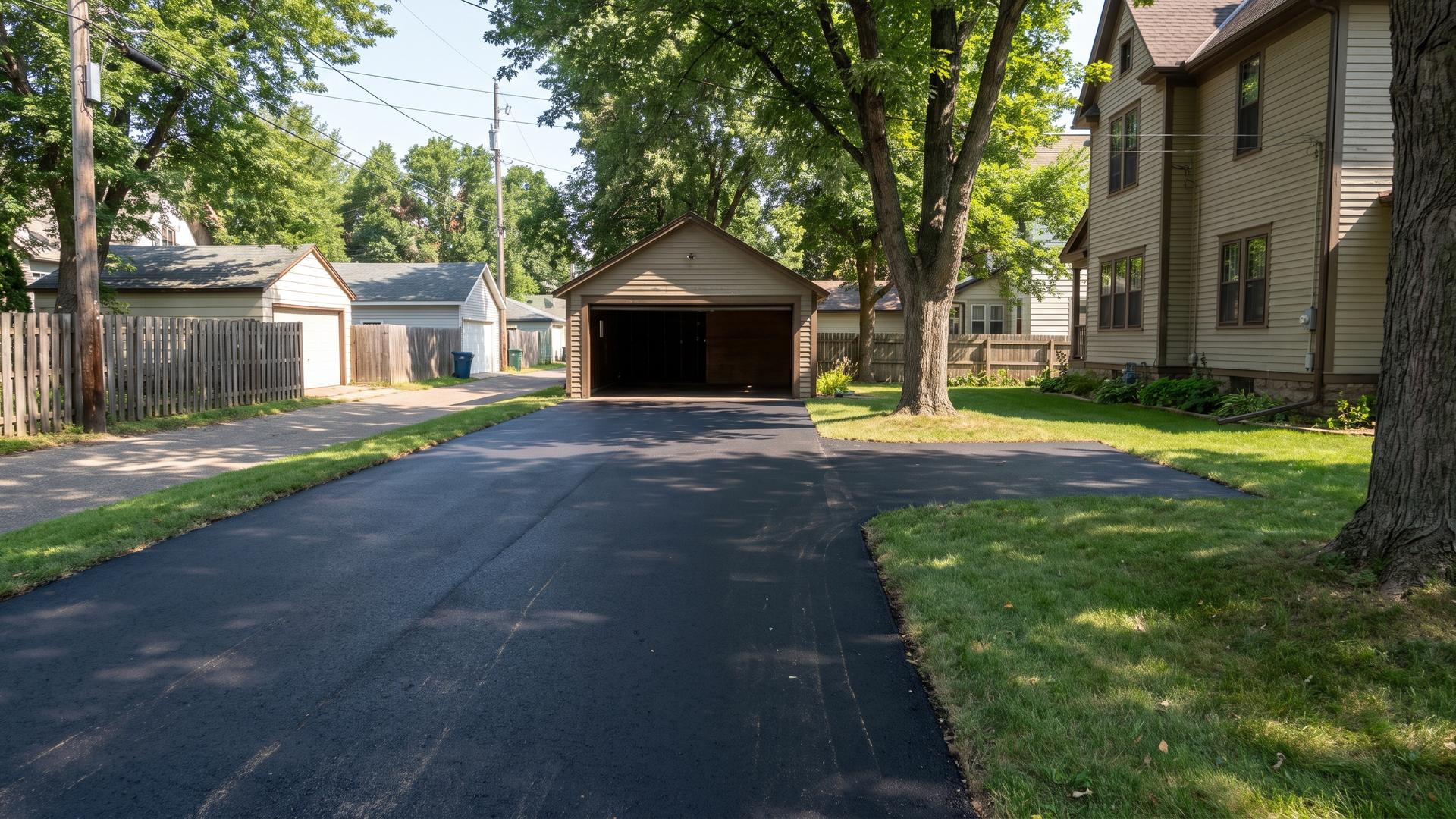
Where garages open onto the city's five miles of alleys, the apron takes the turning load of every car and truck that enters. During a snow emergency, alleys fall under the same 8 a.m. no-parking rule as ordinary streets until they are plowed, so vehicles shuffle between alley and driveway. Add snow that cannot be pushed into the street and melts across the apron, and the cracks at that joint fill with water every thaw. Filling them each spring slows the damage.
What should Robert Street lot owners know about sealing?
Robert Street is known for its 2.5-mile retail strip. Lots along a corridor like that are usually sealed in sections so businesses stay open, restriped once the coating cures, and checked for accessible-stall signs, which Minnesota law says must stay visible from a parked car and clear of snow. Where repair work touches a lot's driveway entrances, curbs or sidewalks, the city's permit rule for laying or repairing them applies, so check with the city before the crew arrives.
Get Your Free West St. Paul Quote
Free quote