Sealcoating Saint Paul Call (651) 321-9442
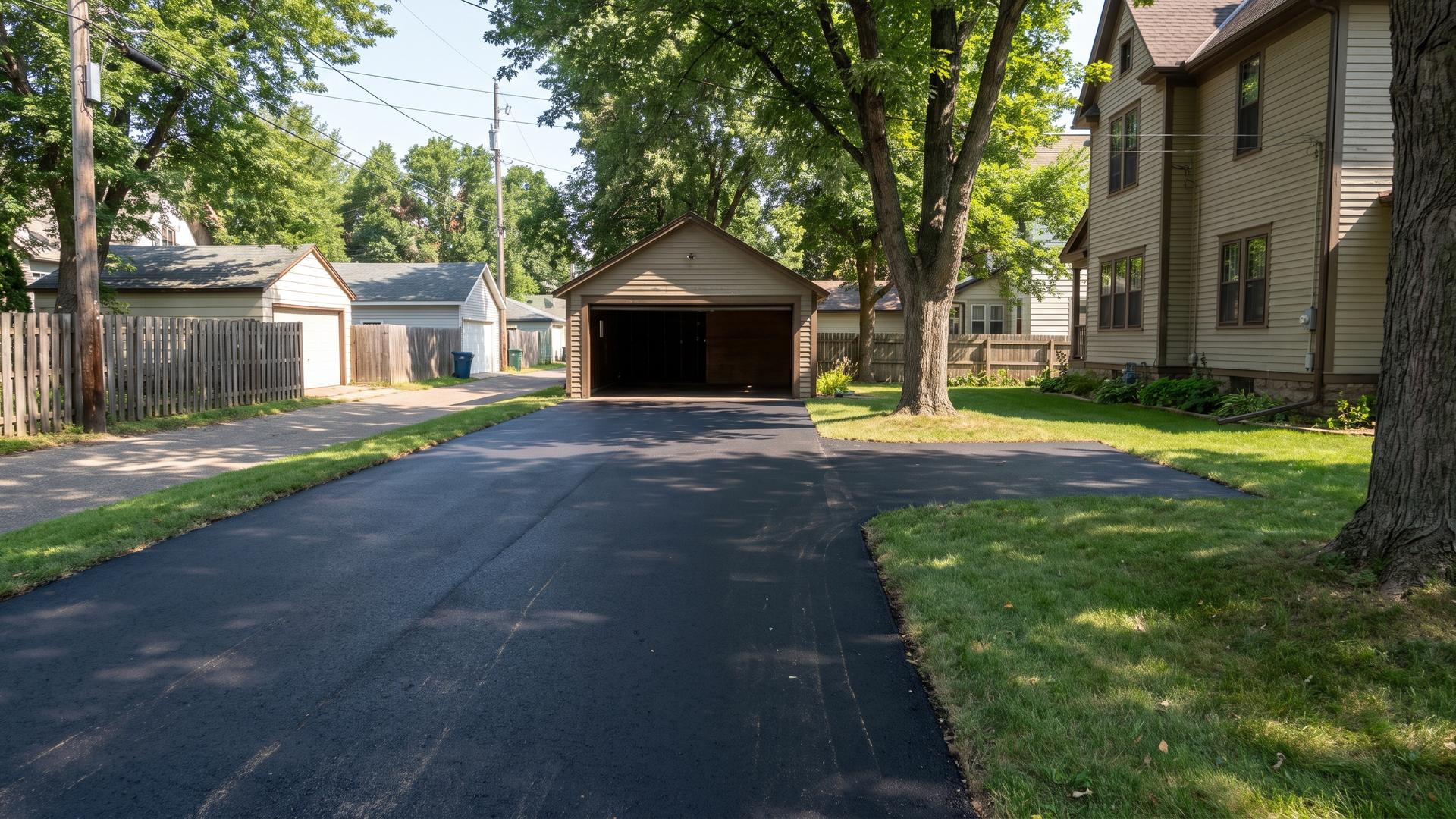
Beside a fenced back alley, a pad of fresh black sealcoat leads to an open two-car garage and a tall tan house

Sealcoating Saint Paul

(651) 321-9442

Free quotes for Saint Paul driveways, alley pads and lots.

Asphalt Sealcoating for Saint Paul Driveways and Alley Pads

At MSP the pavement crosses the freezing line about 78 days a year, and March alone supplies nearly 18 of them. This is what sealing does about that on a Saint Paul drive, and what it costs.

  • About 78 freeze-thaw days a year at MSP airport, per NOAA's 1991-2020 normals
  • 52,147 city housing units were built in 1939 or earlier, per a 2018 city inventory
  • Coal-tar sealer barred statewide since January 1, 2014 under Minn. Stat. 116.202
Alley lots

Why a Saint Paul driveway is often a pad behind the house

Plenty of driveways in this city never reach the street. Saint Paul's zoning rules say access to off-street parking must come from an improved alley wherever one is available, and Public Works counts roughly 2,225 alleys running about 330 miles. So a common job here is a short pad of blacktop between a detached garage and the alley rather than a long strip out to the curb. That changes the work. A small pad has a lot of edge for its size, it meets a concrete garage slab along one side, and in winter it is cleared by whatever private plow the neighbors hired, because the city has never plowed alleys.

The weather supplies the damage. NOAA's 1991-2020 normals for Minneapolis-St. Paul International Airport count 147.7 days a year with a low at or below 32 degrees and 69.2 days when even the high stays there. The gap, about 78.5 days, is how often pavement freezes and thaws within a single day. Those crossings are not spread evenly. January contributes only about 8, because it mostly stays frozen, while March contributes nearly 18 and November about 15. The harm is done in the shoulder months, when snowmelt sits in the cracks by afternoon, and March also averages 10.3 inches of snow, more than February.

What sealer can do about that is narrow, and worth being clear on. Seal coating lays a thin film of asphalt emulsion or acrylic over the surface, so rain, meltwater and the brine carried in on tires stop soaking into the top of the mat, and so sunlight stops oxidizing the binder that holds the stone in place. It adds no strength. Cracks wide enough to take a coin need filling first, and pavement that is sinking or breaking into plates needs patching or replacement instead. Coal-tar products have been barred in Minnesota since January 1, 2014, so whatever goes on a drive here is coal-tar-free.

This site explains driveway sealing, crack filling and asphalt repair for owners of homes, rentals and small commercial lots in the city and the Ramsey County suburbs around it. It publishes observed price ranges on the cost page, sets out the local rules that affect a job, and forwards quote requests to independent local contractors. It does not do the work itself. The climate, street and alley figures appear with their sources and arithmetic on the winter pavement data page, so any number here can be checked.

Free quote

Fields marked * are required.

Fast response during business hours. No obligation.

The work

Sealing, crack filling and patching for Ramsey County blacktop

By a white-railed porch, half the drive wears new black sealcoat and half stays cracked and chalky gray, split by a straight edge

Driveway Sealcoating

Cleaning, crack filling and two coats of asphalt-based or acrylic sealer on Saint Paul driveways and alley pads, timed to the warm, dry weeks between the spring thaw and the first hard frost.

Typical: $290 - $800 for most alley pads and two-car drives; about $0.88 - $2.10 per sq ft

Glossy rubberized crack filler crosses an old, stony driveway in dappled shade leading back to a small cream garage under tall trees

Crack Filling

Hot-pour rubberized filler worked into cleaned cracks on Saint Paul driveways, alley pads and lots, done before sealing so March meltwater stops reaching the base.

Typical: $1 - $3 per linear ft; about $100 - $400 for a typical driveway

Under a canopy of tall street trees, a jet-black saw-cut patch fills the driveway apron between the curb and the sidewalk

Asphalt Patching & Potholes

Cut-out and hot-mix replacement of potholes, sunken spots, broken alley aprons and alligatored sections on Saint Paul drives and pads, finished before sealing so the coat goes on sound pavement.

Typical: $100 - $400 per pothole; $2 - $12 per sq ft for hot-mix or saw-cut patches

New sealcoat darkens the near end of a small lot by a one-story red brick building, the far end still gray with faint lines

Parking Lot Sealcoating

Sealcoating for commercial, church and apartment lots in Saint Paul, with crack filling before and restriping after, scheduled around tenants, snow-storage corners and the city's paving rules.

Typical: $0.14 - $0.25 per sq ft for commercial lots, before crack filling and striping

Between a curbed lawn and an old red brick building with arched windows, crisp white stall lines mark a newly sealed lot

Line Striping

Parking lot striping and line painting for Saint Paul lots after sealing or on its own, including accessible stalls, arrows and fire lanes, laid out to the city's parking lot rules.

Typical: $4 - $5 per standard stall; $25 - $40 per accessible stall

Autumn trees in orange and gold line a sealed, freshly striped lot facing a red brick Gothic church with a square bell tower

Maintenance Plans

A written schedule for a Saint Paul driveway, pad or lot: a spring inspection after the thaw, crack filling as needed, sealing every few years, and repairs caught before the next March.

Typical: Per cycle: sealing at about $0.88 - $2.10 per sq ft plus crack filling at $1 - $3 per ft

A yellow double-drum roller waits beside a steaming new asphalt driveway that runs past a gray-green foursquare house to a two-car garage

Asphalt Paving

New and replacement asphalt driveways and alley pads in Saint Paul, built on a base sized for local soils and frost, with the city's width, material and curb-cut rules checked first.

Typical: $5 - $15 per sq ft installed, new or replacement; overlays about $1 - $3 per sq ft

What this site does differently for Saint Paul owners

Written for alley pads, not only front drives

Most driveway advice assumes a strip of asphalt from the garage to the curb. In Saint Paul, zoning sends parking to an improved alley wherever one exists, and the alley belongs to a network of about 330 miles that the city patches and sweeps but has never plowed. This site treats the pad, the seam at the garage slab and the step down to the alley as the separate problems they are.

Numbers a reader can check

The freeze-thaw count is subtraction on NOAA's normals for the airport station, the soil descriptions are the USDA's, and the street, alley and snow figures come from the city's own Public Works pages. The data page names each source and the value taken from it. Where a fact could not be confirmed, it was left out rather than estimated, and the page says which year a one-season figure belongs to.

Prices on the page before anyone calls

Sealing a 250-square-foot alley pad and sealing a three-car suburban drive are different purchases, and the price table shows both, drawn from published cost guides including HomeGuide, Angi and Fixr. They are observed market ranges, not quotes. An owner who already knows what crack filling typically costs per foot can tell when a bid has buried that line or quietly skipped it.

Independent contractors, and the rules they work under

Quote requests from this site go to independent contractors who work in Ramsey County and the suburbs around it. What the site adds is the rulebook: the concrete-apron requirement in the right-of-way, the curb-cut permit, the 12-foot front-yard width limit, Maplewood's and West St. Paul's own permit triggers and the statewide coal-tar ban. An owner who knows those can read a proposal line by line.

Job sequence

How a sealing job runs between the thaw and the first snow

  1. Walk the pad once the thaw is over

    Inspection is worth doing after the ground has firmed up, which MnDOT marks on state roads by lifting spring load restrictions; in 2026 that happened on April 20 in the Metro zone. Look for spots that sank or rose over the winter, cracks wider than a coin, and edges broken off by a blade. Note exactly where the asphalt stops and the concrete apron or garage slab begins, since those joints are handled differently.

  2. Clean, edge and fill before any coating

    A crew blows out sand and debris, cuts back sod that has crept over the edges, scrubs and primes oil drips so the coating can bond, and cleans every crack it intends to fill. Open cracks feed water straight into the base, so they get hot-pour rubberized filler before any sealer goes down. Sunken spots and alligatored sections are cut out and patched at this stage, never coated over.

  3. Coat only in the warm, dry stretch

    Sealer makers write their rules in degrees, not dates. GemSeal calls for pavement and air at 50 degrees or warmer and rising, with no rain forecast for 24 hours. By the airport normals, June averages about 3 nights at 50 or below and July and August about one between them, while May averages 17 or 18 and October about 27. The coating stops where the concrete apron begins.

  4. Keep wheels and blades off until it cures

    Latex-ite's data sheet puts cure time at 24 to 48 hours at 70 degrees and 50 percent humidity, and GemSeal notes that drying takes about twice as long at 50 degrees as at 80. On a shared alley, that means warning the neighbors who cross the pad. Before the first snow, stakes along the edges give the alley plow operator a line to follow, which spares the fresh edges from the blade.

Ground truth

Sand, silt, limestone and 78 freeze-thaw days a year

Under the lawns and alleys, much of the city sits on glacial outwash sand that drains fast. The 2006 Local Surface Water Management Plan maps the uplands as Urban land-Chetek-Mahtomedi and Urban land-Waukegan-Chetek complexes, with Kingsley-Mahtomedi and Urban land-Copaston along the Mississippi. The USDA's official series descriptions fill in the detail. Chetek is 12 to 20 inches of loamy material over sandy and gravelly outwash, rated somewhat excessively drained; Mahtomedi is sandy outwash rated excessively drained. Frost heave needs three things together, fine-grained soil, freezing temperatures and a supply of water, and clean sand lacks the first. On the sandier blocks, the bigger threats to a driveway are at the surface: oxidized binder, open cracks and unsupported edges.

The exceptions matter before anyone prices a repair. Waukegan soils carry 50 to 100 centimeters of silty loess or alluvium over the outwash, roughly 20 to 39 inches, and silt is exactly the kind of fine soil that holds water and heaves. Kingsley, mapped along parts of the river, formed in reddish brown sandy loam till with moderate to moderately slow permeability. Along the river corridor, Copaston is only 10 to 20 inches deep over limestone, and the surface water plan lists Decorah shale, the Platteville and Glenwood formations and St. Peter sandstone among the city's bedrock layers, with rock exposed along the bluffs. A pad can straddle two of these, which can explain one corner that lifts every spring while the rest stays flat.

Frost reaches deep here. Minnesota Rules part 1303.1600 places Ramsey County in frost Zone II, where building footings must go at least 3-1/2 feet down. For pavement, the thaw is the dangerous part: as ice in the ground melts, the water cannot drain away fast enough and the subgrade loses bearing capacity. MnDOT handles that on state roads with seasonal weight limits, and in 2026 spring load restrictions in the Metro frost zone ran from March 3 to April 20. The same logic applies at home. Those are the weeks to keep dumpsters, concrete trucks and moving vans off the blacktop, whatever the calendar says about spring.

The housing stock is old even by Midwestern measures. The city's 2018 housing inventory, drawing on 2012-2016 census estimates, counted about 119,625 housing units, 52,147 of them built in 1939 or earlier, and found that 57 percent of single-family, duplex and triplex buildings went up before 1930. Nearly half the stock predates 1940 and about 90 percent predates 1980. No asphalt surface has lasted as long as those houses have stood, so the pavement behind them is a later addition or a later replacement, often with more than one generation of patch in it, and a repair estimate should start by finding out what is underneath.

The city's winter routine shapes what ends up on a driveway. Saint Paul plows 1,874 lane miles with about 80 plows and other pieces of equipment, and it often declares a snow emergency after 3 inches or more. Plows leave windrows across driveway ends, and the city does not come back for them; shoveling, pushing or blowing that snow into the street or alley is not permitted, and the city's guidance is to store it on the property. Salt is lighter on many blocks than people assume, because the city does not typically salt residential streets, while arterials get pretreated with brine. Across the Twin Cities metro, though, the MPCA estimates 365,000 tons of road salt go down each year, and some of it arrives on every tire.

Three rules decide a lot of driveway projects in this city. First, off-street parking must be paved with asphalt, concrete or pavers; gravel and crushed rock do not qualify, and a front-yard driveway tops out at 12 feet wide, except within 30 feet of the garage door, where it may run 4 feet wider than the door. Second, a new curb cut through the sidewalk and boulevard needs a permit from Public Works, which does not allow asphalt for aprons or boulevards in the right-of-way without its director's approval; that is why the piece by the street is concrete. Third, Minnesota Statutes section 116.202 bans both selling and applying coal-tar sealant, and the MPCA notes that the ban reaches out-of-state applicators working under contract here.
Prices

Observed price ranges for sealing and repair in Saint Paul

The figures below are observed market ranges taken from published cost guides, mainly HomeGuide, Angi, Fixr and HomeAdvisor, and matched to the sizes of pavement common in Saint Paul. They are not quotes, and none of those guides publishes a separate Twin Cities figure for sealing. Where a guide prices by the square foot, the row states the size assumed. Minimum charges matter more here than in the outer suburbs: HomeGuide lists minimum service fees of $100 to $250 for asphalt repairs, and a single-car alley pad can land close to that floor.

Service Typical Saint Paul Range
Single-car alley pad or short drive, about 250-290 sq ft, cleaned and sealed $290 - $580
Two-car drive, about 400 sq ft (20 x 20 ft), cleaned and sealed $355 - $800
Three-car or long suburban drive, about 750-860 sq ft, cleaned and sealed $860 - $1,700
Hot-pour crack filling $1 - $3 per linear ft
Questions

What Saint Paul owners ask before booking a seal job

What do owners in Saint Paul typically pay to have a driveway sealed?

Published cost guides put a small drive or alley pad of about 250 to 290 square feet at roughly $290 to $580, a 400-square-foot two-car drive at about $355 to $800, and installed rates between about $0.88 and $2.10 per square foot. Crack filling is often priced separately at $1 to $3 per linear foot. These are observed market ranges from HomeGuide, Angi and Fixr, not quotes; the full price table shows which source backs each line and what moves a price up or down.

When can driveways be sealed in Saint Paul?

Sealer manufacturers want pavement and air at 50 degrees or warmer and rising, plus a dry 24 hours. At the airport station the median last spring frost at 32 degrees falls on April 25 and the median first fall frost on October 10, but nights at 50 or below are still common in May and return in late September. Late May through mid-September is the dependable stretch, with warm spells in early May and early October as a gamble. The sealing season post walks through it month by month.

Is coal-tar sealer still used anywhere in Minnesota?

Not legally on pavement. Minnesota Statutes section 116.202 prohibits applying coal-tar sealant products to asphalt and prohibits selling products formulated or marketed for that use, and the MPCA says the ban took effect January 1, 2014. The agency attributes 67 percent of the PAH contamination found in stormwater-pond sediments to coal-tar sealants and counts roughly 15,000 stormwater ponds in the Twin Cities metro. Washington State banned the product first, in 2011, and Minnesota followed; White Bear Lake had already passed the state's first municipal ban.

Who takes care of the alley behind the garage?

Mostly the neighbors. The city describes its alley upkeep as minimal, meaning pothole patching and a spring sweep, and it has never plowed, salted or sanded alleys in winter; keeping them open falls to the abutting owners, usually through an informal alley captain who hires a private plow. Owners also maintain their own driveway aprons and the connection between the pad and the alley. When a whole alley needs rebuilding, Public Works chooses projects each year, and assessable costs to owners typically stay at or below 25 percent. The alley driveway guide covers the rest.

Should the concrete apron at the street get sealed too?

No. On most lots the stretch between the sidewalk and the street is concrete by rule: Public Works does not allow asphalt in the right-of-way for driveway aprons or boulevards unless its director approves it, and concrete work there may only be done by a contractor holding the city's permits, with an inspection called before the pour. Asphalt sealer is made for asphalt. The clean joint where the blacktop meets the concrete is where the coating should stop.

Does resealing an existing driveway need a city permit?

The city's residential parking handout ties permits to two things: a new curb cut through the sidewalk and boulevard, which needs a Public Works permit, and parking areas of four or more spaces, which go through site plan review. Parking areas of three or fewer spaces need no permit and carry no application fee. Resealing or filling cracks on an existing pad is not listed as a permit item, but widening a drive or cutting a new opening to the street is, and the suburbs write their own rules.

How often does a Saint Paul driveway need a fresh coat?

HomeGuide gives a range of every 2 to 10 years, which is too wide to use by itself. The short end fits a pad in full sun that takes road brine off tires every winter and shows gray, open texture by its third spring; the long end fits a shaded drive that sees little traffic. A drop of water makes a decent test. If it soaks in and darkens the surface within a minute, the top of the mat has opened up and is ready for another coat.

Why does one corner of the pad lift every spring?

Usually because of what sits under that corner. Frost heave needs fine-grained soil, freezing temperatures and water at the same time. Much of the city is clean outwash sand that drains fast, but Waukegan soils put 20 to 39 inches of silt over that sand, and old fill, a downspout or a low spot at the garage slab can supply the water. A corner that rises and settles every year is a signal to look below the surface; sealing will not stop it, and a base repair may.

Is the seal coating the city puts on streets the same thing?

No, and the difference is instructive. Public Works chip-seals residential streets: a distributor truck sprays hot liquid asphalt, a spreader drops torpedo gravel or crushed granite chips into it, and a rubber-tired roller presses them in, leaving loose stone for several days until the sweepers return. Each residential street gets it about every eight years, roughly one-eighth of the city per summer, prepared in July and applied in August, though the program was postponed in 2025. Driveway sealer is a fine emulsion squeegeed or sprayed on, with no layer of chips.

How long should a new asphalt drive wait before its first seal?

Longer than most owners expect. Fresh asphalt needs time to finish curing before a coating goes over it, and published guidance varies: HomeGuide says 3 to 6 months, while Latex-ite's data sheet asks for at least one full season and recommends 12 months. With most paving here done between late spring and fall, that usually means sealing the following summer rather than the same one. The asphalt paving page covers base and thickness for a new drive.

Coverage

Saint Paul neighborhoods and the suburbs next door

Highland Park Macalester-Groveland Summit Hill Como Park Hamline-Midway St. Anthony Park Payne-Phalen Dayton's Bluff Battle Creek Highwood North End Roseville Maplewood Woodbury West St. Paul Falcon Heights South St. Paul Mendota Heights

Request a quote for a Saint Paul driveway, pad or lot

Describe the pavement and the alley or street it opens onto; the request goes to independent contractors who work in Ramsey County and nearby suburbs.

Free quote

Fields marked * are required.

Fast response during business hours. No obligation.